
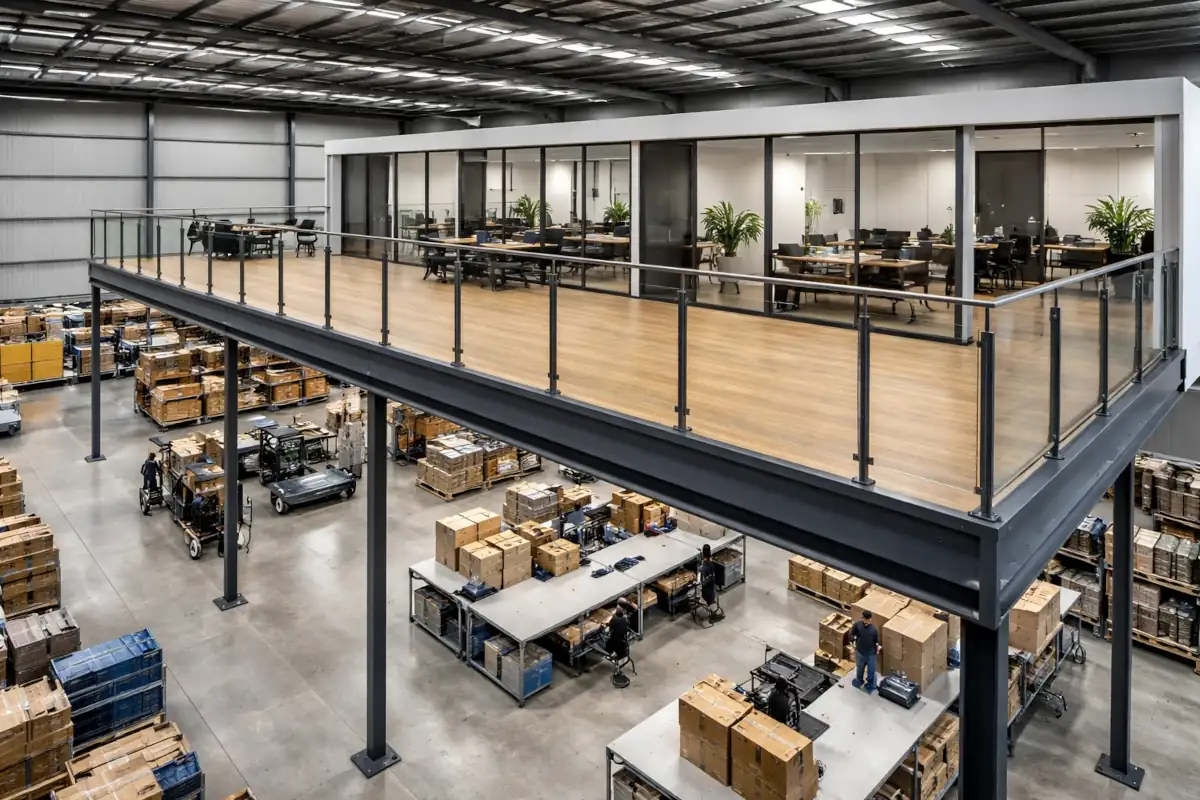
A showroom has two jobs that pull in opposite directions. The front of house needs to look good and be easy for customers to walk around. The back of house needs room for stock, spare parts and a working workshop. A well-planned showroom mezzanine design lets you do both in the same building, by moving storage and support functions upstairs and keeping the ground floor for customers and product.
This guide is written for car, marine and trade dealers and retailers. It covers display, customer-facing finishes and parts storage above, based on what we see across our projects at FMF.
Showroom mezzanine design: why dealers look up
Dealerships tend to run out of floor space in the same way. Stock ranges grow, parts inventories expand, and the display floor gets crowded by boxes and shelving that customers should never see. Moving to a bigger site is expensive and often means leaving a location your customers already know.
A mezzanine adds usable floor area inside your existing building. In a showroom, that usually means parts storage moved above the workshop or display floor, offices and sales areas lifted off the ground, and cleaner, more open display space below.
Our mezzanine floors page covers the basic options, and our custom mezzanines service is worth a look if every building and range of stock is different.
Decide what the customer should see
The first design decision is what belongs in front of customers and what does not. A simple way to organise this is to sort your space into three zones.
- Display and sales. Product, signage, counters and walkways. This is the area customers judge you on.
- Support. Workshop, service and handover areas, where staff work with customers and vehicles or equipment.
- Back of house. Parts, accessories, packaging and records.
The mezzanine is usually the best home for the third zone, and sometimes the second. Putting back of house upstairs frees up the ground floor for the first two.
Display ideas for a showroom mezzanine
Keep the ground floor clear and uninterrupted
Customers need to see and walk around product without columns and shelving in the way. When you plan a mezzanine over part of the floor, keep the support grid out of your key display areas where you can. Clear spans give you flexibility to re-merchandise the floor later, which is useful when ranges change.
Use the upper level to extend the range
The mezzanine can carry display too, not just storage. Marine retailer Sirocco Marine needed more space to display and store its expanding range of inflatable boats and parts, from luxury yacht tenders to high-speed rescue vessels. The challenge was to increase floor space while keeping an engaging customer experience. Our Sirocco Marine project is a useful reference for that balance between display and storage.
Treat the mezzanine edge as part of the display
The front edge of a mezzanine is in view from the moment a customer walks in. It can look like industrial plant, or it can look like part of the building's design. In our Private Mezzanine project, the front edge was in constant view and had to look intentional rather than industrial, with stairs and handrails integrated without crowding the space.
Light the space under the mezzanine
A mezzanine casts shade on the area beneath it. Plan the lighting under the overhang as carefully as the display itself, so products still look their best.
Customer-facing finishes
Surfaces matter most where customers walk, wait and make decisions. These are the details that tend to separate a showroom from a warehouse.
- Stairs and handrails. If customers will use them, finish them as you would a feature. Wide treads, good lighting and a clean handrail design all help. Our mezzanine stairs and mezzanine handrails pages show the options.
- Floor finishes. Carpet, vinyl or sealed floor finishes suit customer areas. Steel framing with timber decking or polished concrete can give a modern industrial look that suits trade and automotive brands.
- Soffit and ceiling. The underside of the mezzanine is what customers see looking up, so a clean, lined soffit beats exposed services.
Finishes for the parts level can be simpler and tougher, because customers will not see them.
Parts storage above: the practical side
Most dealerships and trade retailers want a mezzanine mainly for parts, and that is where a showroom mezzanine design pays for itself.
Mike Carney Toyota is a good example. The dealership needed more space for spare parts storage to serve regional clients quickly, and long freight delays from capital cities meant more stock had to be held on site. The first project was a 180 m² mezzanine for workshop parts, and a second followed. Read about the Mike Carney Toyota project and the later 300 square metre mezzanine, which was installed within an existing live workshop.
Another automotive-style example is the Working Class Van mezzanine, where the brief called for very high headroom so large vans could drive and park beneath the platform, with minimal posts in the work envelope and a quick flow of picking stock above and installing below.
Design points for a parts mezzanine
- Load. Tell your designer what you will store so the floor can be engineered for it.
- Access for goods. A mezzanine goods lift or pallet gates let you move stock safely without carrying it up the stairs.
- Shelving and layout. Plan aisle widths and shelving before the structure is set.
- Security. If you want controlled access to a parts area, plan it in from the start, as in the Transport Innovations/The Iceman Group project, which included a purpose-built spare parts department with controlled access and visibility.
Keep the business trading while you build
Most showrooms cannot afford to close. The second Mike Carney Toyota mezzanine went into an existing live workshop, and our aim on every job is no downtime. Christmas-period shutdowns and freight delays can slow some jobs, so plan early.
Approvals and certification
A showroom mezzanine is building work, so you need to plan for approvals. Under NCC 2022 Volume One, clause C2D3(4), a mezzanine is regarded as a storey for rise-in-storeys calculations if its floor area is more than 200 m² or more than one-third of the floor area of the room, whichever is the lesser, and multiple mezzanines at or near the same level are added together (NCC 2022, Part C2). Your certifier or building surveyor will confirm how that applies, and the approval pathway for your state and site.
Plan your showroom mezzanine with FMF
If you are planning a showroom mezzanine design for your dealership or trade store, call our team on 1300 998 883 or request a free quote. We can book an obligation-free site consult to look at your floor, your stock and your customers' route through the building.
FAQs
Will a mezzanine reduce the headroom in my showroom?
It will change it under and above the platform, so clear height is one of the first things we check. Projects such as the Working Class Van mezzanine show that very high headroom beneath a platform can be designed for.
Can the mezzanine be built while we keep trading?
Our aim is no downtime, and we have built in live premises. The practical details depend on your site, so we confirm them at the site consult.
Can a mezzanine be both a display area and storage?
Yes. A mezzanine can be zoned so that part of it supports display or customer viewing while the rest holds stock. The layout, access and finishes for each zone need to be planned together, and your certifier will confirm what the intended use requires.
- Mezzanine Floor Maintenance: Maximise Longevity & Safety
- How to Maintain Your Mezzanine Floor for Maximum Longevity
- How to Reconfigure a Mezzanine Floor as Your Business Grows
- Warehouse Layout Ideas with Mezzanine Floors: How to Plan the Zones, Flow and Access
- How a Mezzanine Floor Increased Productivity by 40%
- Buying a Mezzanine Floor: Quoting Mistakes That Cost Businesses Money
- Mezzanine Fire Safety NSW: Approvals, Certifiers and Ongoing Obligations
- Mezzanine Fire Safety Requirements: How the NCC Treats Mezzanines
- Mezzanine Installation Mistakes: What Goes Wrong on Site and How to Avoid It
- Retail Stockroom Mezzanine on the Gold Coast: Free Up Your Shop Floor