
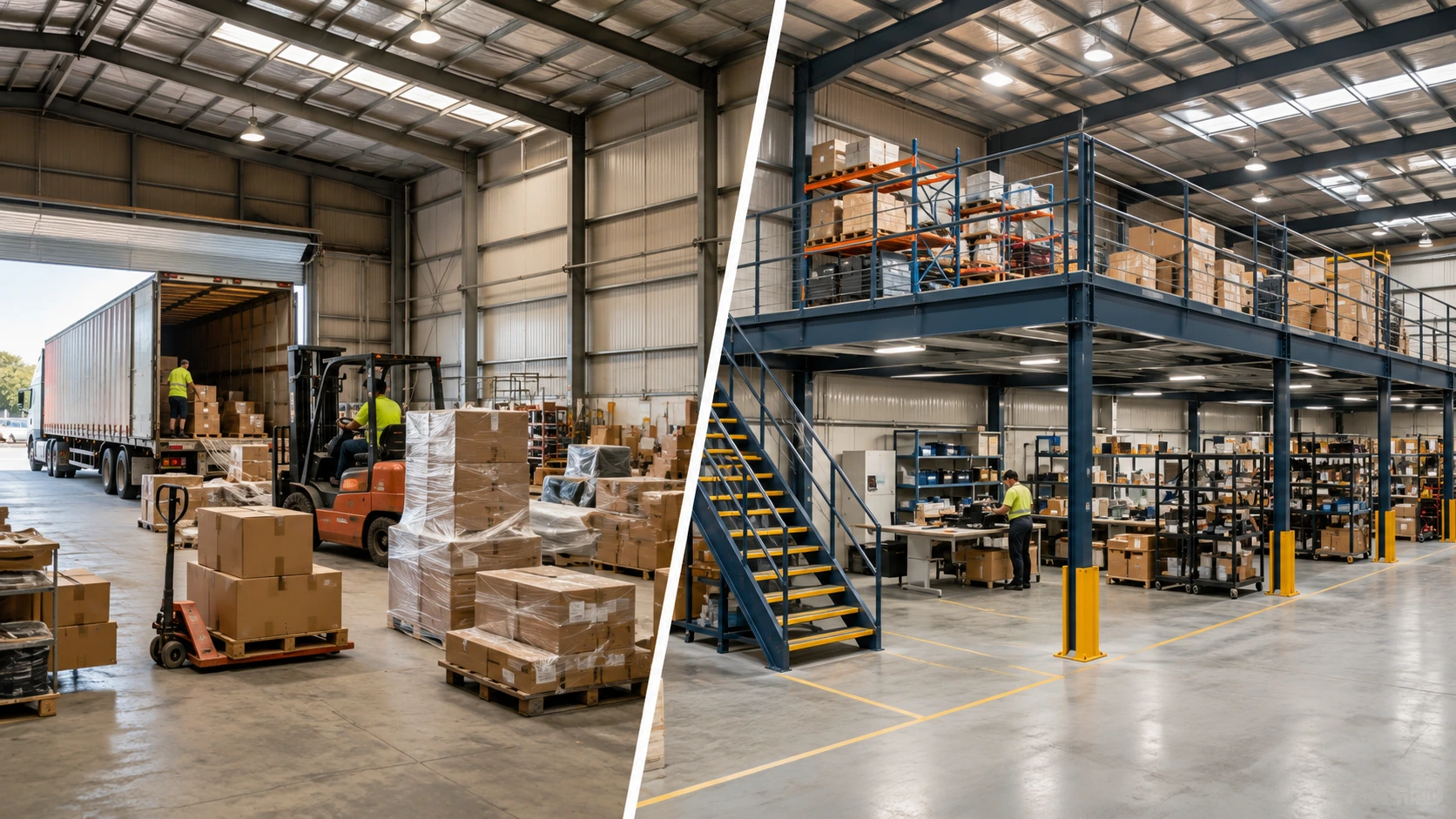
As businesses grow, one challenge almost every warehouse, factory and industrial facility eventually faces is running out of space. The question then becomes: should you relocate to a larger premises or maximise the building you already have?
While moving to a bigger facility may seem like the obvious solution, it is rarely the most cost-effective one. For many Australian businesses, installing a mezzanine floor delivers the additional space they need without the significant financial burden and operational disruption that comes with relocating.
In this guide, we'll compare the costs, benefits and real-world outcomes of both options to help you determine which investment provides the greatest return.
The True Cost of Relocating
Relocating involves far more than simply leasing a larger warehouse.
Many businesses underestimate the hidden expenses involved, including:
- Commercial lease or property purchase costs
- Bond and legal fees
- Warehouse fit-outs
- Moving equipment and inventory
- New racking and storage layouts
- Downtime during the move
- Lost productivity
- Staff disruption and longer commuting times
- Potential interruptions to customer deliveries
Even after operations resume, businesses often face higher ongoing expenses through increased rent, insurance, utilities and property maintenance.
Perhaps the biggest hidden cost is lost productivity. Every day spent packing, moving and recommissioning equipment is time your business isn't operating at full capacity.
For companies with established workflows, these indirect costs can quickly exceed the visible moving expenses.
Why More Businesses Are Choosing Mezzanine Floors
Rather than expanding outward, many Australian businesses are expanding upward.
A mezzanine floor creates an additional level inside your existing building, making use of valuable vertical space that would otherwise remain unused.
This allows businesses to increase usable floor area without relocating, often while continuing normal operations throughout much of the installation process.
Typical applications include:
- Additional warehouse storage
- Office space
- Packing stations
- Production areas
- Showrooms
- Spare parts storage
- Staff amenities
Because each mezzanine is custom engineered, it can be designed around your workflow rather than forcing your business to adapt to a new building.
Comparing the Costs
Although every project differs, comparing the two options highlights why mezzanine floors are often the more economical solution.
Relocation costs
Relocation typically includes:
- New lease or purchase expenses
- Commercial fit-outs
- Removalists and transport
- Equipment disassembly and installation
- IT and electrical relocation
- Downtime
- Staff retraining and workflow changes
- Higher ongoing occupancy costs
Mezzanine floor costs
A mezzanine project generally includes:
- Site assessment
- Structural engineering
- Steel fabrication
- Installation
- Staircases and safety barriers
- Council approvals where required
- Certification
Unlike relocation, these costs are largely one-off investments that directly increase the functionality of your existing facility.
Business Benefits Beyond Cost Savings
The financial savings are only part of the equation.
Installing a mezzanine floor offers several operational advantages that continue delivering value long after installation.
Minimal disruption
One of the biggest advantages is reduced disruption.
Unlike relocation, where operations may slow or stop entirely, many mezzanine installations can be completed in stages, allowing businesses to continue trading with minimal interruption.
Faster expansion
Finding suitable industrial property can take months.
A mezzanine project can often be designed, approved and installed significantly faster than sourcing and relocating to new premises, allowing businesses to respond more quickly to growth.
Improved workflow
Rather than simply creating more room, a well-designed mezzanine can improve operational efficiency.
Businesses commonly use separate levels for:
- Inventory storage
- Order fulfilment
- Offices
- Manufacturing
- Staff facilities
This creates better organisation, smoother workflows and improved productivity.
Future flexibility
Many modern steel mezzanine floors are standalone structures that can be modified, expanded or even relocated if business needs change in the future.
That flexibility makes them a valuable long-term investment rather than a permanent limitation.
Case Study: Automotive Parts Storage
Factory Mezzanine Floors recently completed a 300m² mezzanine for Mike Carney Toyota.
The business required additional spare parts storage while continuing to operate its busy workshop.
Instead of relocating, a second mezzanine level was installed within the existing facility, increasing storage capacity while avoiding the disruption and expense of moving to a larger premises.
The project demonstrates how businesses can continue growing while remaining in their established location.
Case Study: International Cost Comparison
International studies also highlight the financial advantages of mezzanine construction.
One published project involving a sporting goods distribution facility achieved savings of approximately US$644,000 by selecting a lighter engineered mezzanine solution instead of a more extensive structural alternative.
While every project differs, the example illustrates how carefully planned mezzanine solutions can significantly reduce capital expenditure while still delivering the additional space required.
When Relocation Makes More Sense
Despite their many advantages, mezzanine floors aren't always the right answer.
Relocation may be the better option if:
- The building has insufficient ceiling height.
- Structural limitations prevent additional loading.
- Your business requires substantially more land.
- Access for heavy vehicles is inadequate.
- The property's location no longer suits your operations.
- Lease conditions prevent significant alterations.
In these situations, relocating may better support long-term business objectives despite the higher upfront investment.
Questions to Ask Before Deciding
Before committing to either option, consider the following:
Can your existing building support a mezzanine?
A structural assessment will determine whether the building is suitable.
How much additional space do you actually need?
Many businesses discover that an extra level provides more than enough room without requiring a larger building.
What will relocation really cost?
Include downtime, labour, customer disruption and increased operating costs—not just removal expenses.
How quickly do you need the additional space?
A faster solution often delivers earlier returns on investment.
Will your business continue growing?
Choose a solution that supports future expansion while maintaining flexibility.
Which Option Delivers Better Value?
For most warehouses, factories and industrial facilities, installing a mezzanine floor provides the strongest financial return.
It allows businesses to:
- Maximise existing floor space
- Avoid relocation expenses
- Minimise operational disruption
- Improve workflow efficiency
- Increase property functionality
- Continue operating from an established location
Relocation certainly has its place, particularly when location or site limitations become major obstacles. However, when the primary challenge is simply running out of usable space, building upwards is often the smarter financial decision.
Conclusion
Growing businesses don't always need a bigger building—they often just need to use their existing one more effectively.
A professionally engineered mezzanine floor transforms unused vertical space into valuable working area while avoiding many of the hidden costs associated with relocation.
At Factory Mezzanine Floors, every project is custom designed to suit your building, operational requirements and future growth plans. From initial consultation through to engineering, fabrication and installation, the goal is simple: create more usable space with minimal disruption and maximum long-term value.
If your business is weighing up expansion options, comparing a mezzanine solution alongside relocation costs could reveal significant savings—and help you grow without moving.
- How to Maintain Your Mezzanine Floor for Maximum Longevity
- Ways to Reconfigure Your Mezzanine Floor as Your Business Grows
- Before & After: Transforming Warehouse Layouts with Mezzanine Floors
- How a Mezzanine Floor Increased Productivity by 40%
- Common Mistakes to Avoid When Installing a Mezzanine Floor
- Mezzanine Floors vs. Relocation: Which Saves More Money?
- 5 Signs Your Business Needs a Mezzanine Floor
- The Importance of Professional Engineering in Mezzanine Design
- How to Ensure Your Mezzanine Floor Meets Fire Safety Standards in Australia
- How to Ensure Your Mezzanine Floor Meets Fire Safety Standards