
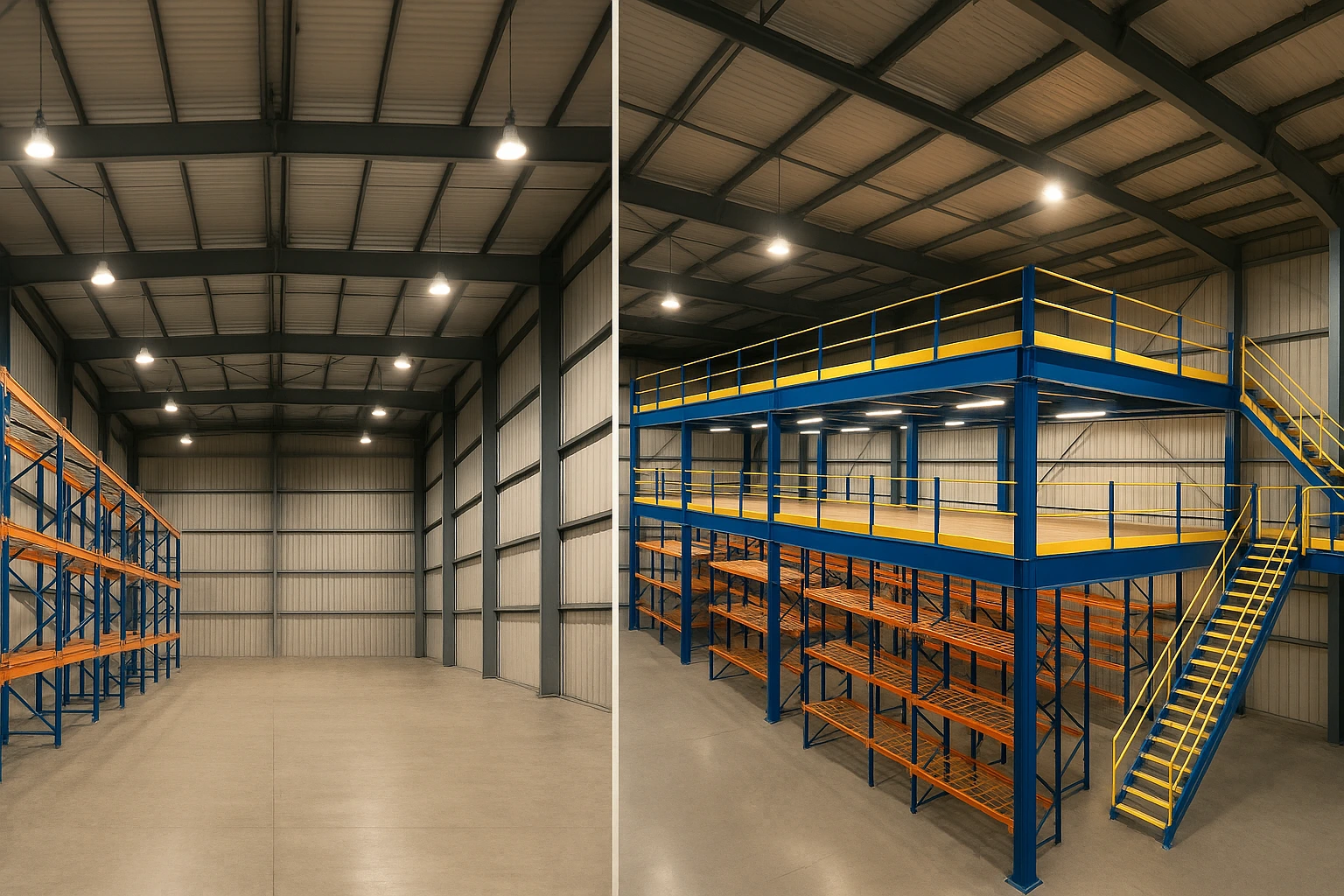
Warehouses rarely stay the same for long. Products change, volumes increase, processes evolve—and at some point, every facility reaches that uncomfortable moment when the layout no longer works. Aisles get tighter. Stockrooms overflow. Teams operate around inefficiencies they’ve simply learned to tolerate.
But the interesting thing is this: most warehouses don’t struggle because of a lack of space. They struggle because they aren’t using their space as effectively as they could.
That’s where a mezzanine floor steps in. It’s one of the most transformative upgrades any warehouse can make—an intervention that reshapes both the physical layout and the way teams move, store, and work. When you compare the “before” and “after,” the difference is rarely subtle. It’s dramatic.
Below, we'll explore how mezzanine floors deliver those transformations in real-world settings, what actually changes on the warehouse floor, and how businesses unlock additional capacity without relocating or rebuilding. Throughout, you’ll find internal linking cues where you can anchor readers to deeper content about installation, maximising space, and reconfiguration strategies.
Before: The Constraints of a Single-Level Warehouse
Spend enough time in warehouses and you start to recognise the same pain points over and over again—signs that a facility is working harder than it needs to:
1. Underused vertical height
Most warehouses have more air than floor space. It’s not uncommon to see 6–10 metres of vertical clearance being wasted simply because the facility layout was never designed to use it. Racking can only reach so high. Workspaces can’t float above the floor. And so a third of the building becomes an unreachable void.
2. Bottlenecks in workflow
When storage sprawls horizontally, travel time increases. Pick rates slow down. Staff start crossing paths in unpredictable ways. Seasonal surges make everything tighter.
3. Expansion that feels impossible
Many warehouse managers reach a point where they believe their only options are:
- extend the building,
- relocate, or
- accept the current limitations and hope demand stabilises.
Each option comes with major cost, planning complexity, or operational downtime.
4. A layout that doesn’t evolve with the business
Modern warehouses need flexibility. Product lines change. Teams grow. Operations diversify. But a single-level layout tends to lock a business into one way of working.
What’s striking, though, is how quickly these challenges disappear once a mezzanine floor is introduced.
After: A Multi-Level Warehouse Built for Growth
A mezzanine floor doesn’t just “add space”—it reorganises the entire layout into something more strategic, efficient, and future-proof. Think of it as giving your warehouse a second life.
1. Turning unused height into premium floor space
The most immediate “after” effect is the sheer volume of new space created. A professionally engineered mezzanine—whether single- or multi-tier—can double or even triple usable floor area without increasing the building’s footprint.
Under the structure, businesses often establish:
- organised shelving bays,
- bulk storage,
- pick faces,
- packing lines, or
- workstation clusters.
Above it, the space becomes ideal for:
- staging and sorting,
- additional storage,
- assembly areas,
- office pods,
- QC labs, or
- dedicated processing zones.
Suddenly, the warehouse becomes a layered environment where every cubic metre is accounted for.
(Insert link to “Maximise Space” post.)
2. A smoother, safer workflow
Once space pressure is relieved, everything starts to flow better. Teams can move with purpose rather than working around obstacles. Pallet movements become simpler. Pick paths shorten. And because mezzanine designs can be tailored to the operation—handrails, gates, decking, stairs, and load ratings—the end result feels like a warehouse built intentionally for productivity.
I’ve seen businesses reduce congestion almost overnight. By relocating packing stations to the upper level and reorganising pick locations below, they’ve cut walking distances dramatically. Many managers comment that it feels like an entirely new facility, even though nothing changed externally.
3. Expansion without relocation
One of the biggest “aha” moments for businesses happens when they realise they don’t actually need a larger building—they just need to unlock the space they already own.
Mezzanine floors allow companies to:
- increase stockholding capacity,
- accommodate new product lines,
- add more work zones, and
- scale with seasonal surges
—all without the cost and disruption of moving.
Compared to a relocation project—which might involve months of planning, lease negotiations, and downtime—a mezzanine installation can often be completed with minimal operational impact, especially when phased strategically.
(Insert link to “Installation” post.)
4. A layout built for future reconfiguration
One misconception we often hear is that a mezzanine is a permanent fixture. In reality, well-designed mezzanines are modular. They can be extended, reduced, repositioned, or reconfigured as your warehouse evolves.
For fast-growing businesses, that flexibility is a major advantage. Instead of redesigning the entire facility every few years, the mezzanine becomes a dynamic hub that adapts as needs shift.
For example:
- Need additional office space? Add an upper-level office pod.
- Bring in a new product line? Extend the mezzanine by another bay.
- Switching from bulk storage to higher pick rates? Reconfigure stair access and create a dedicated pick zone.
The “after” state doesn’t have to be a final destination—it can be the beginning of ongoing optimisation.
(Insert link to “Reconfiguration” post.)
Before & After: Real-World Scenarios
To illustrate the transformation more tangibly, here are a few scenarios Warehouse Managers commonly experience:
Scenario 1: The Overflowing E-Commerce Facility
Before:
Pallets stacking up in aisles, packed packing benches, and constant pressure during peak seasons.
After:
A mezzanine creates an elevated packing and dispatch area, while the space underneath becomes neatly organised racking for fast-moving SKUs. Pickers have shorter routes and packers work without congestion.
Scenario 2: The Manufacturer Needing More Production Space
Before:
Production line squeezing too close to storage areas; limited room for assembly; staff working in cramped conditions.
After:
A mezzanine is installed to house assembly and QA stations on the upper level. Below it, raw materials and components are sorted logically. The production line expands without extending the building.
Scenario 3: The 3PL Facility Adapting to New Contracts
Before:
Different clients’ stock intermingled; lack of dedicated zones; inefficient inbound/outbound flow.
After:
The mezzanine provides the structure to create client-specific storage clusters, dedicated staging, and high-volume pick faces. The warehouse becomes a flexible, multi-client operation with room to grow.
Before and After: The Psychological Impact
This is something people rarely talk about, but it’s real: when a mezzanine goes in, morale often increases. Teams feel like they’re working in a more professional, organised environment. Managers suddenly see future capacity instead of constraints. And owners gain confidence in scaling their business without fear of outgrowing the premises.
A warehouse that once felt chaotic becomes something entirely different—a facility with direction, structure, and momentum.
Why Mezzanine Floors Work So Well
At its core, the power of a mezzanine floor comes from one simple idea: vertical efficiency. Most facilities waste enormous amounts of cubic space. Mezzanines reclaim it. They don’t fight the building—they work with it.
Combined with intelligent planning, strong structural engineering, and a clear vision of how the space should function, mezzanines deliver a practical, cost-effective upgrade that traditional construction simply can’t match.
Final Thoughts
If you've reached the point where your warehouse feels full, disorganised, or limiting, you're not alone. Many facilities look “maxed out” long before they truly are. The shift from a one-level layout to a multi-level environment is one of the most impactful operational upgrades available—and in many cases, the results speak for themselves within weeks.
The “before and after” comparison isn’t just about more space. It’s about better space. Smarter processes. A layout that supports your team and your growth.
And often, it all starts with a simple question: Are you fully using the warehouse you already have?
FAQs
Where Does Your Business Operate?
We deliver Custom mezzanines across Queensland including Brisbane, Gold Coast, Sunshine Coast, Toowoomba, Ipswich, Logan, Redlands, Bundaberg, Baringa, Coolum, Cooyroy, Redbank, Yatala Rockhampton, Mackay, Townsville, Cairns and regional QLD.
What mezzanine load ratings can you design for (office vs palletised storage)?
We design to your use case—office live loads through to heavy palletised storage—engineered to AS/NZS 1170 and documented in your certification pack.
Do I need engineering if it’s just for storage?
Yes. Every mezzanine—regardless of use—must be structurally certified for safety, compliance, and long-term use.
Can the design allow for future expansion?
Yes. We can design your mezzanine for future expansion.
- How to Maintain Your Mezzanine Floor for Maximum Longevity
- Ways to Reconfigure Your Mezzanine Floor as Your Business Grows
- Before & After: Transforming Warehouse Layouts with Mezzanine Floors
- How a Mezzanine Floor Increased Productivity by 40%
- Common Mistakes to Avoid When Installing a Mezzanine Floor
- Mezzanine Floors vs. Relocation: Which Saves More Money?
- 5 Signs Your Business Needs a Mezzanine Floor
- The Importance of Professional Engineering in Mezzanine Design
- How to Ensure Your Mezzanine Floor Meets Fire Safety Standards in Australia
- How to Ensure Your Mezzanine Floor Meets Fire Safety Standards