
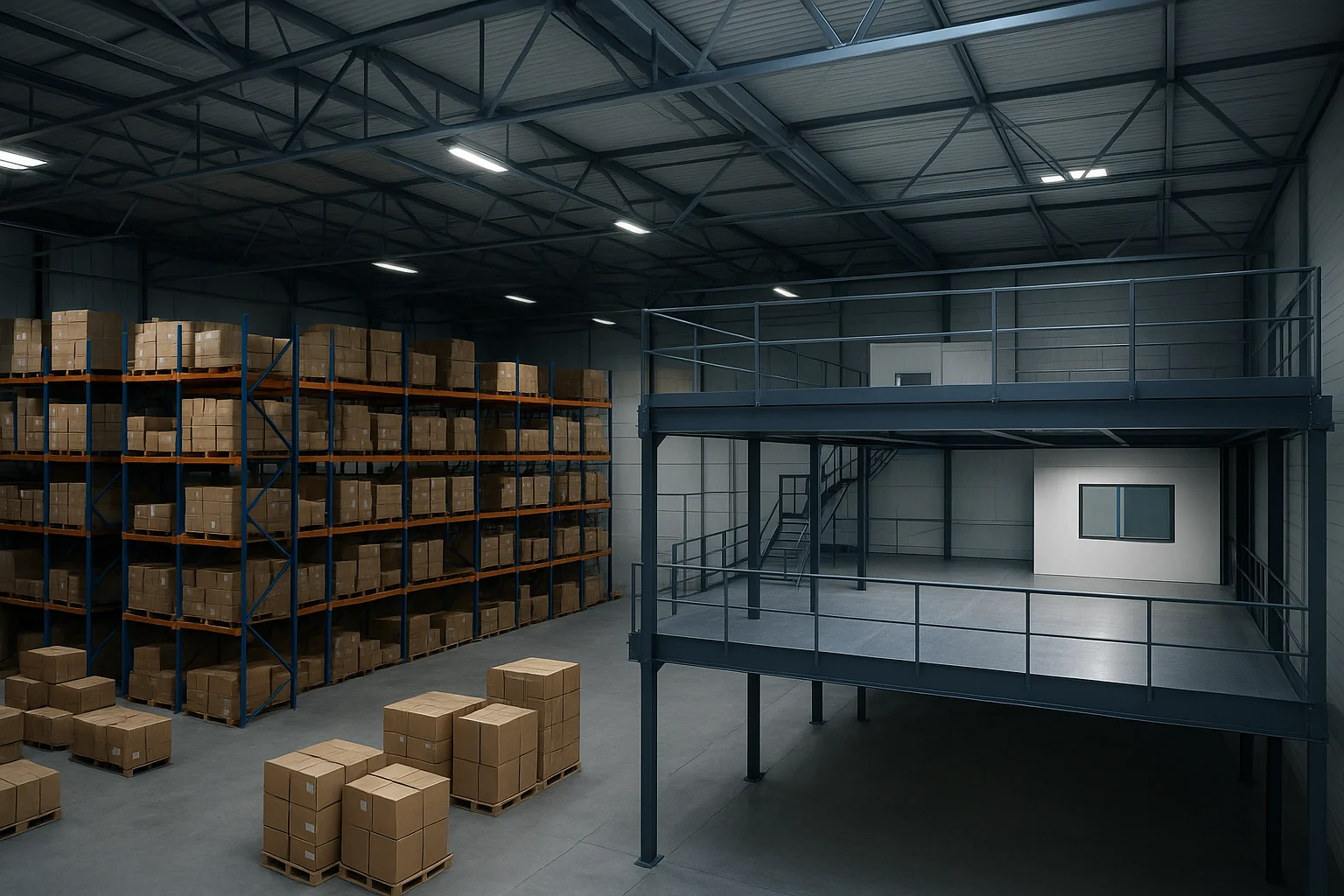
When a facility starts to feel cramped and growth is hampered by space constraints, two major options often surface: move to a larger facility (relocate) or stay in place and build up by installing a mezzanine floor. As someone who’s worked with warehouse managers and facility planners, I’ve seen both paths pursued—and often the more expensive and disruptive choice is made simply because it feels like the “bigger” solution. But is it the smarter one? In this article we’ll dig into costs, benefits, case studies and decision criteria to help you understand whether a mezzanine floor is the better financial choice compared to relocation.
The Cost of Relocation: Hidden & Real
Relocation is more than just a new lease or building footprint. It includes:
- Finding a suitable property (often at higher rent per m²).
- Modifying the space to fit your operation (racking, layout changes, M&E works).
- Physical moving of inventory, equipment, staff and processes—often days or weeks of downtime or reduced throughput.
- Disruption to your supply chain, increased transport or staff commuting costs, potential customer dissatisfaction.
- Lease termination or dual rent overlaps if you keep your old site while ramping up the new one.
- Increased utilities, insurance and property tax in a new / better location.
- The longer-term fixed commitment of a new lease—what happens if you grow again or need to shrink?
Industry commentators highlight that moving to a larger warehouse can be “costly and time-consuming” compared to other options. For example, one analysis points out that building a new warehouse can cost around £72-£90 per square foot, whereas installing a mezzanine may cost about £7-£11 per square foot in some UK examples.
So while relocation offers space and possibly better facilities, the financial cost and operational risk are often higher than many anticipate.
What a Mezzanine Floor Costs — and the Financial Upside
A mezzanine floor is an intermediate platform installed in an existing building, effectively creating an additional usable level. L Let’s look at the cost structure and savings:
Cost Structure
Key cost items include:
- Structural assessment and reinforcement (columns, footings, connections) to ensure the building can take the added loads.
- Steel framing, decking, stairs, access, barriers, and finishing.
- Safety and building-code compliance (guardrails, fire-escape, etc.)
- Operational disruption during installation (though generally shorter and less intense than relocation).
Savings & Pay-back
Some of the clear financial advantages:
- Utilises “unused” vertical space instead of expanding footprint or moving.
- Avoids the higher rent, fit-out, and downtime costs associated with relocation.
- Modularity/flexibility: many mezzanine systems are designed to be reconfigured or expanded, offering future-proofing.
- Better workflow: by reorganising space and zoning operations, you may gain faster throughput, lower labor cost per unit, and less wasted movement.
One striking case: a large sporting goods facility compared a concrete mezzanine build vs. a lighter mezzanine solution and saved US$ 644,000 on that project alone. That shows the magnitude of savings when you carefully choose the mezzanine route rather than heavier permanent work.
But It’s Not Always a Clear Win — When Relocation Makes Sense
There are scenarios where relocation is the better or even only viable strategic move:
- If your current building has very low ceiling height, insufficient structural capacity, or zoning/lease constraints that prevent a mezzanine.
- When location itself is a strategic disadvantage (e.g., poor access, far from transport hubs, labor pool issues).
- If business growth projections require a radical scale-up or completely different property footprint (e.g., a manufacturing facility moving into a high-ceiling automated environment).
- If the cost to retrofit (structurally reinforce) is prohibitively high compared to the cost of a new facility.
Indeed, sources caution that mezzanines have “up-front costs” and may require permits and structural work; so they are not always a no-brainer.
Real-World Case Studies and Cost Figures
- The sporting goods retailer example I mentioned above: replacing a heavy concrete mezzanine with a lighter mezzanine saved US$ 644 000.
- One Australian blog notes: “By installing a mezzanine floor you can add up to 50% more floor space without spending a lot of money on renovations or on moving to a new facility.”
- Another UK analysis states that while building a new warehouse can cost about £72-£90/ft², a mezzanine may be £7-£11/ft² in the right scenario.
- A cost-benefit article emphasises how mezzanines allow utilization of vertical space, avoiding building expansions or relocation.
These real-world data points reinforce that mezzanines often deliver major cost savings and quicker ROI versus relocation.
Practical Decision Framework: When to Choose Mezzanine vs. Relocation
Here’s a practical framework for facility decision-makers (warehouse managers, facility planners, business owners) to work through.
- Assess current facility constraints
- Ceiling height, structural capacity, building codes.
- Current lease terms: remaining term, renewal options, rent escalation.
- Location advantages/disadvantages: labour, transport, customers.
- Estimate mezzanine cost + implementation time
- Get quotes for structural work, installation, safety compliance.
- Estimate downtime/disruption during installation.
- Determine expected additional usable space and improved workflow.
- Estimate relocation cost + timeline
- Search and lease/purchase cost for new facility.
- Fit-out/lay-out modification, move cost, downtime cost.
- Ongoing rental (or ownership) cost, increased utilities/maintenance.
- Calculate ROI & payback
- For mezzanine: cost divided by added usable space + operational improvements (storage efficiency, labor savings).
- For relocation: cost divided by benefits (space, location, labour savings).
- Also consider non-monetary: risk of disruption, staff turnover, lost customers.
- Consider long-term flexibility & growth
- Can mezzanine be expanded later? If business growth continues, will you need more than a mezzanine can provide?
- With relocation: does new facility offer head-room for future growth?
- Risk assessment
- Mezzanine: structural surprises, permit delays, restricted clearance.
- Relocation: market availability of good site, lease risks, cost overruns, business downtime.
- Make the decision
- If mezzanine cost is a fraction of relocation cost, growth requirement moderate, and current location acceptable → go mezzanine.
- If growth demands massive footprint or location change is strategic → consider relocation.
Summary: Which Saves More Money?
In most mainstream warehouse or light-industrial operations where the challenge is “we’re running out of space but the building is structurally sound and well located”, installing a mezzanine floor almost always offers better financial value and less disruption than relocating. The evidence is strong:
- Much lower cost per extra square metre.
- Faster implementation.
- Less disruption to operations.
- Retains staff and location advantages.
- Adds value to existing property.
Relocation remains a powerful tool—but primarily when constraints are structural, location-based or growth-driven in a way that cannot be addressed by building up rather than moving out.
In short: If you can use your vertical space now, avoid paying for a whole new site and the chaos of moving. A mezzanine floor is not just a “fix” — it’s a strategic investment in your current assets. As one industry commentator puts it: “Putting up a mezzanine is far speedier and more cost effective than moving and setting up from scratch.”
Call to Action
If you’re evaluating your next capital expansion project, take the time now to commission a mezzanine feasibility study alongside a relocation cost model. Compare both side-by-side with realistic timelines, costs, and disruption estimates. You’ll likely find that the smarter, faster, and more economical choice is to stay put and build up rather than pack up and move out.
FAQs
Is there a cost for the initial consultation?
No. Our first discussions and site visits are obligation-free. We’re here to help you explore your options.
What factors do you consider during the consulting process?
We review your available space, structural constraints, intended usage (storage, office, machinery), load requirements, council obligations, and long-term business goals.
Can you work with my property manager or landlord?
Yes. We regularly coordinate with property managers, landlords, and owners to ensure all parties are aligned during the approval process.
Can you give me a price before a site visit?
We can often provide a budget range based on initial information, but a detailed, fixed quote requires a site measure to confirm dimensions and any technical factors.
- How to Maintain Your Mezzanine Floor for Maximum Longevity
- Ways to Reconfigure Your Mezzanine Floor as Your Business Grows
- Before & After: Transforming Warehouse Layouts with Mezzanine Floors
- How a Mezzanine Floor Increased Productivity by 40%
- Common Mistakes to Avoid When Installing a Mezzanine Floor
- Mezzanine Floors vs. Relocation: Which Saves More Money?
- 5 Signs Your Business Needs a Mezzanine Floor
- The Importance of Professional Engineering in Mezzanine Design
- How to Ensure Your Mezzanine Floor Meets Fire Safety Standards in Australia
- How to Ensure Your Mezzanine Floor Meets Fire Safety Standards