
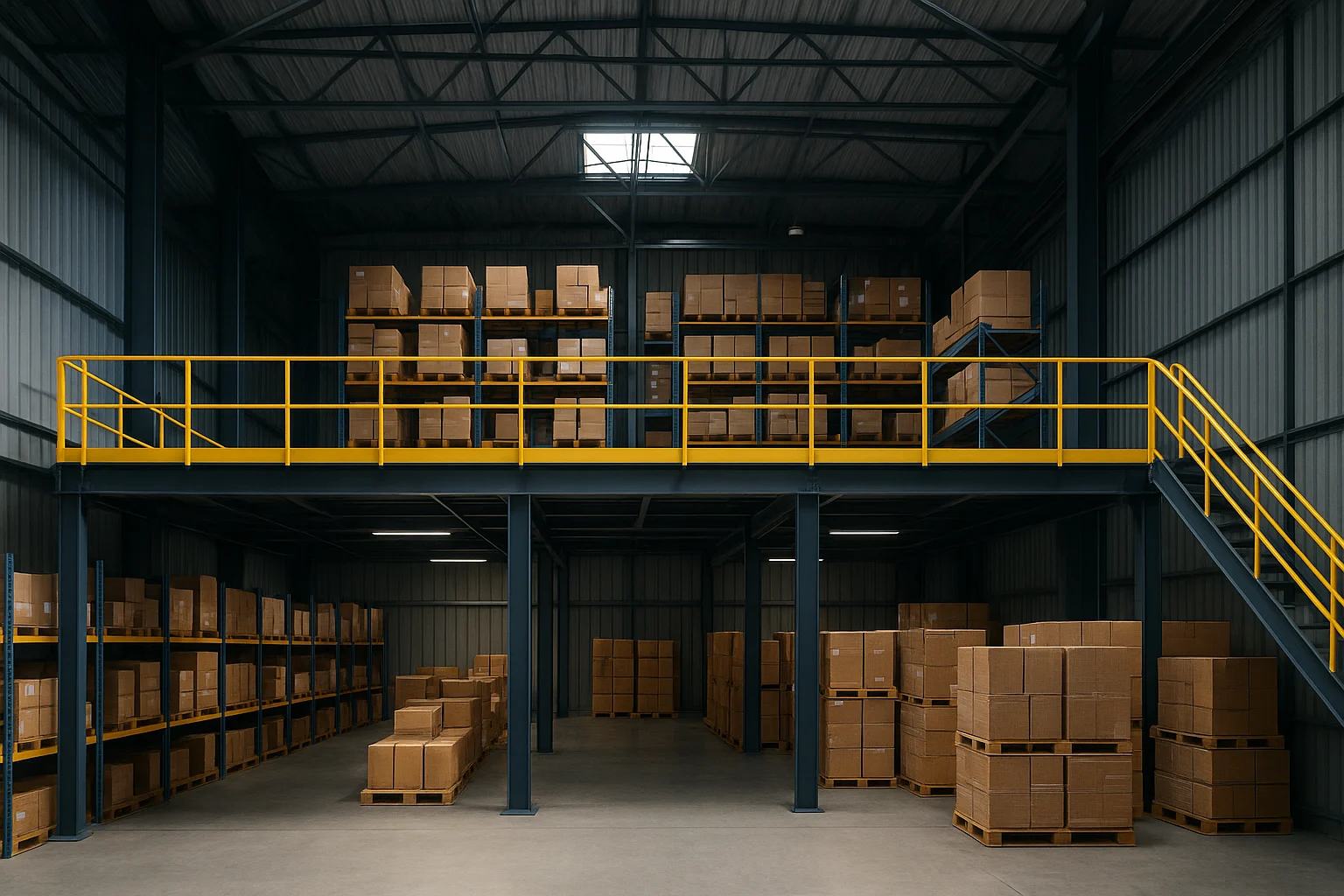
In many warehouses, factories or large-scale commercial spaces, the ground floor layout feels full—every nook and aisle accounted for—but one thing often goes overlooked: the vast empty space above. In my experience working with facility planners and warehouse managers, we consistently find that there’s a goldmine of ‘air-space’ above head height that, when harnessed correctly, becomes a game-changer. This is where a mezzanine floor steps in.
Tap into the vertical dimension
A mezzanine floor (essentially an elevated platform built within your existing building height) lets you utilise that unused volume. According to industry guidance, mezzanine installations can “effectively double or even triple your usable area without expanding your building’s footprint.”
For instance: if you have a warehouse with 6 metres of clear ceiling height, you could insert a mezzanine at around 3 metres high, leaving the floor underneath clear for ongoing operations and the mezzanine above for storage. Suddenly, the “square metres” available for storage are doubled—but the building footprint stays exactly the same.
Why this matters to warehouse managers and business owners
- Cost-effective expansion: Compared to moving premises, building an extension, or leasing additional space, a mezzanine is far more economical. One article emphasises that installing a mezzanine floor is “significantly less invasive and utilises the existing structure of the building.”
- Minimal disruption: Because you aren’t tearing down walls or relocating operations, installation can often occur while your facility remains operational.
- Improved workflow and storage organisation: With a mezzanine, you can allocate high-volume or less‐frequently-used inventory to the upper level and keep high-turnover items, production or dispatch below. This zoning improves movement, reduces bottlenecks and helps teams work more efficiently.
Doubling your storage: how the mechanics work
- Evaluate clear height: You need sufficient head-room both above and below the mezzanine deck to ensure usability and safety. Without that, the mezzanine isn’t effective. As noted by experts reviewing mezzanine costs and design, “clear heights starting from 2,400 mm to 2,954 mm … overall heights up to 3,267 mm” were cited as workable in one Australian example.
- Design the mezzanine for your load and layout: Are you storing palletised inventory, bulk bins or lightweight items? The load capacity, racking layout, and access method (stairs, lifts, conveyors) all matter. One article emphasizes that mezzanines allow you to create “a blank canvas for flexible storage or bays of racking.”
- Integrate with existing operations: The best mezzanine solutions don’t disrupt what’s already working. That means planning for stairways, guardrails, clearance for forklifts or equipment underneath, and ensuring that the new level integrates seamlessly with your workflow.
- Ensure compliance and safety: A mezzanine floor still demands engineering certification, compliance with building codes and occupational safety standards. For example: guardrails, handrails, appropriate load ratings, and safe access. Without this, your ‘free’ storage could become a liability.
The tangible benefits you’ll see
- Greater storage capacity without footprint expansion: Several references confirm that businesses have “doubled their inventory volume just by adding a structural or racking-based mezzanine system.”
- Improved operational efficiencies: By segregating areas—stock above, shipping/processing below—you reduce interference between activities and accelerate workflows. One case study described a 25 % increase in productivity after implementing a mezzanine inventory level.
- Faster return on investment: Because the initial investment is lower than relocation or major construction, and because you derive added value quickly, the ROI tends to be favourable.
- Flexibility for future growth: Many mezzanine systems are modular and can be re-configured or extended as business needs evolve. One article highlights this scalability: “Mezzanines allow you to plan for future developments without committing to large warehouse expansions.”
Real-world illustration
Imagine a warehouse with 10,000 m² of floor space and a clear internal height of 7 m. If they install a mezzanine platform at 3.5 m, covering 80 % of the floor area (8,000 m²), they achieve approximately an additional 8,000 m² of usable space above. In effect, their usable space almost doubles (from 10,000 m² to ~18,000 m²) without renting, constructing or acquiring any extra land. With proper racking and layout, that additional space might house extra inventory, spare parts, or even a dedicated returns processing area.
Key considerations before proceeding
- Structural capacity & approvals: Make sure the building can support additional loads from the mezzanine, plus stored goods. Engage structural engineers and ensure compliance.
- Access and clearance: Ensure that stairways, lifts or conveyors provide safe and efficient access to the mezzanine level. Also check that overhead clearance below remains adequate for equipment.
- Workflow impact: Map out how goods will move to and from the mezzanine. Stock placed on the upper level still needs retrieval – inefficient access will erode the benefits.
- Future flexibility: Consider how your mezzanine supports future layout changes, expansions or varying loads. Some systems are more adaptable than others.
- Safety and maintenance: Set up regular inspections, load-monitoring, clear signage for weight limits, and maintenance routines. A mezzanine is an asset only if it remains safe and functional.
Final thoughts
If your business is feeling the squeeze on floor space but you’re fortunate enough to have high ceilings and unused vertical ‘air’, then installing a mezzanine floor presents one of the most effective ways to increase storage capacity without expanding your footprint.
In short: you’re not adding square metres to your building—you’re multiplying the usable capacity of the metres you already own.
For warehouse managers, facility planners and business owners looking to optimise space and cut costs, a steel-framed mezzanine floor offers a compelling solution: faster installation, lower disruption, strong ROI and fewer headaches than relocation or full building expansion.
In my experience, once the decision is made and the installation is well designed and executed, people often look up and wonder, “Why hadn’t we done this sooner?”
If you’d like, I can provide a checklist of what to evaluate before choosing a mezzanine system (clear height, load ratings, design options, etc.), or case studies of companies who have doubled their storage with mezzanines. Would you like me to prepare that?
FAQs
Where Does Your Business Operate?
We deliver Custom mezzanines across Queensland including Brisbane, Gold Coast, Sunshine Coast, Toowoomba, Ipswich, Logan, Redlands, Bundaberg, Baringa, Coolum, Cooyroy, Redbank, Yatala Rockhampton, Mackay, Townsville, Cairns and regional QLD.
What mezzanine load ratings can you design for (office vs palletised storage)?
We design to your use case—office live loads through to heavy palletised storage—engineered to AS/NZS 1170 and documented in your certification pack.
Do I need engineering if it’s just for storage?
Yes. Every mezzanine—regardless of use—must be structurally certified for safety, compliance, and long-term use.
Can the design allow for future expansion?
Yes. We can design your mezzanine for future expansion.
- How to Maintain Your Mezzanine Floor for Maximum Longevity
- Ways to Reconfigure Your Mezzanine Floor as Your Business Grows
- Before & After: Transforming Warehouse Layouts with Mezzanine Floors
- How a Mezzanine Floor Increased Productivity by 40%
- Common Mistakes to Avoid When Installing a Mezzanine Floor
- Mezzanine Floors vs. Relocation: Which Saves More Money?
- 5 Signs Your Business Needs a Mezzanine Floor
- The Importance of Professional Engineering in Mezzanine Design
- How to Ensure Your Mezzanine Floor Meets Fire Safety Standards in Australia
- How to Ensure Your Mezzanine Floor Meets Fire Safety Standards