
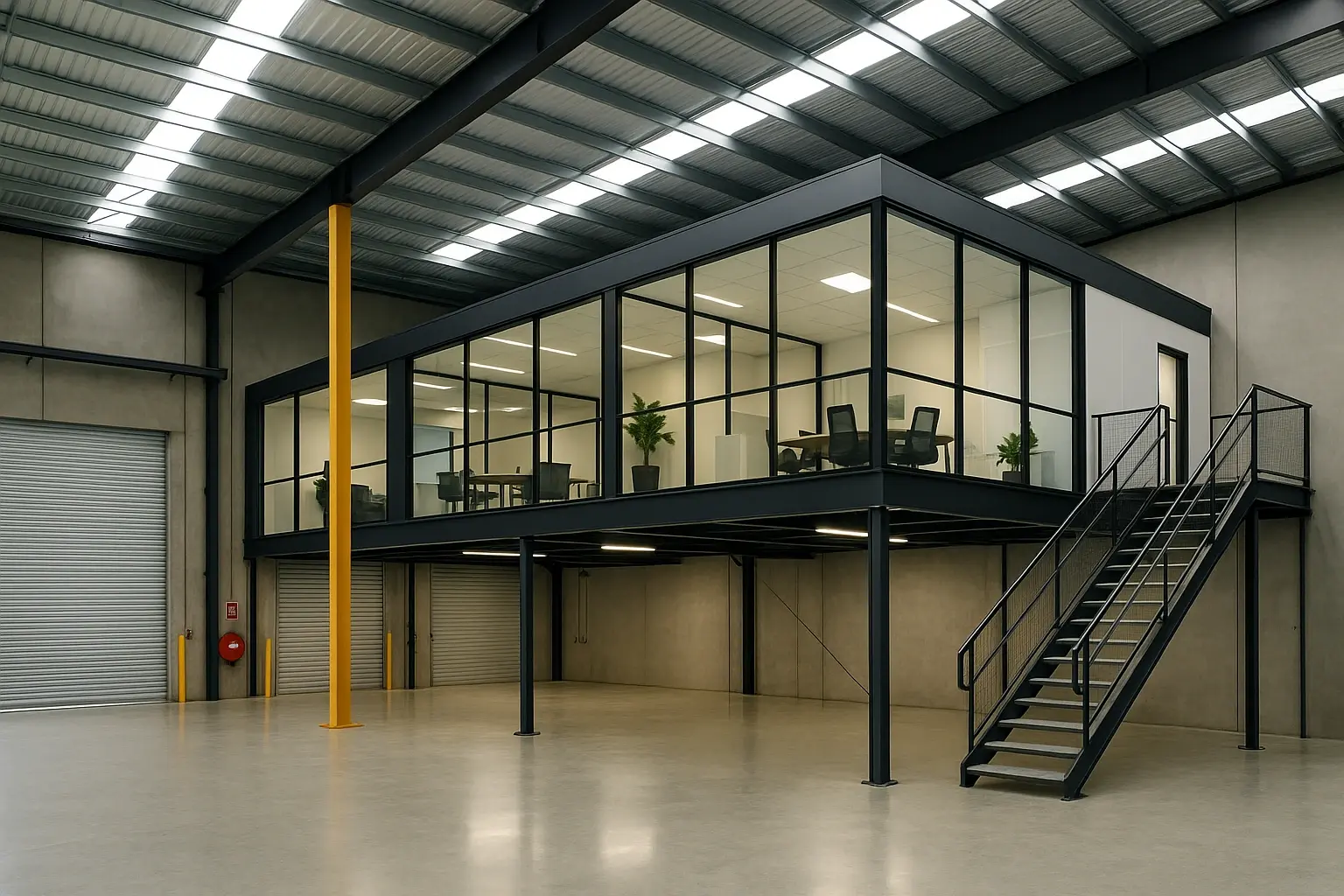
The deck is the part of a mezzanine your people and your stock actually touch every day. It decides how the floor feels underfoot, how it handles forklifts and trolleys, how it copes with spills and how much it adds to the budget. This guide compares the main mezzanine flooring options, with the pros and cons of each, so you can brief a designer with confidence.
Start with the use, not the material
Different mezzanines ask very different things of the floor. Before you compare products, answer four questions.
- What load will it carry? Office furniture and people are very different to palletised stock or machinery. We design to your use case, from office live loads through to heavy palletised storage, engineered to AS/NZS 1170 and documented in your certification pack.
- What will move across it? Foot traffic, trolleys, pallet jacks and forklifts wear a floor differently.
- What could spill or fall on it? Oil, water, dust and sharp-edged stock all affect the choice.
- Who looks at it? Offices are judged on appearance. Storage is judged on durability.
Structural particleboard or timber-based flooring
This is the traditional choice for storage and office mezzanines. Structural flooring panels are laid over the steel framework and fixed down, giving a continuous, flat surface.
Pros
- A flat, solid surface that suits pallet jacks, trolleys and general foot traffic
- Quiet underfoot compared with bare steel
- A good base for carpet, vinyl or other finishes in office areas
- Often a cost-effective way to cover a large area
Cons
- Not suited to constant wetting or heavy spills unless protected
- Surface can wear in aisles with heavy, repeated wheeled traffic
- May need a protective topping or sealed finish for demanding use
Panel type, thickness and fixing are an engineering decision tied to your joist spacing and load.
Steel plate flooring
A steel plate deck gives a very strong, continuous surface. It is a common answer where the floor needs to take hard use.
Pros
- Excellent durability under heavy loads and wheeled traffic
- A continuous surface, so small items do not fall through
- Resists impact better than most panel products
- Can be coated for corrosion protection
Cons
- Heavier than panel flooring, so it affects the structure and the support below
- Plain smooth plate can be slippery, especially when wet or oily
- Noisier underfoot and under trolleys
- Usually costs more than a panel deck
Checker plate
Checker plate is steel plate with a raised pattern rolled into the surface. It is a familiar sight on stairs, landings and walkways in industrial buildings.
Pros
- A raised pattern that improves grip compared with plain plate
- Strong, long-lasting and low-maintenance
- Works well on stair treads, landings and platforms as well as main decks
- Gives a clearly industrial look that suits workshops and plant areas
Cons
- Still a steel deck, so it is noisy and heavier than panel flooring
- The raised pattern can be harder to clean where fine dust or liquids collect
- Not the most comfortable surface for staff who stand all day
- Not the right visual fit for a client-facing office unless covered
For slip-resistance requirements, your certifier or engineer will confirm what applies to your stairs, landings and walkways. For an example of a project with higher-than-standard stair and handrail requirements, see our SEQ Water project, which included certified slip-resistant tactiles and a client specification for tread construction and handrail height.
Mesh grating
Mesh or bar grating is an open deck. Light, air and water pass through it, which makes it the right tool in a few specific situations.
Pros
- Light passes through, so the area below stays brighter
- Liquids and debris fall through rather than sitting on the surface
- Lighter than solid steel plate
Cons
- Small items, tools and dropped parts can fall through to the floor below
- Heels, pallet-jack wheels and trolley wheels can catch in the openings
- Not a comfortable surface for long periods of standing
- Not suitable for most office or customer areas
Grating is best on walkways, maintenance platforms and plant access. Whether it suits your building will depend on the use, the building classification and fire and sprinkler arrangements, which your certifier or building surveyor will confirm.
Finishes: what goes on top of the deck
The deck is only half of the answer. The finish decides how the floor looks, wears and cleans.
- Carpet tiles and vinyl. The usual choice for mezzanine offices. They soften noise, look professional and can be replaced in sections.
- Polished or sealed floor treatments. These suit showrooms and client areas where appearance matters. Mixed materials such as steel frames with timber decking or polished concrete finishes remain popular for modern industrial looks.
- Epoxy and other protective coatings. Useful over panel or steel decks where the surface needs to resist wear or be easy to wipe down.
- Anti-slip coatings and tapes. Often used on steel plate, stair treads and landing areas.
Choosing between mezzanine flooring options
In short: panel decks with carpet or vinyl suit offices, a panel or steel plate deck suits general storage, checker plate suits stairs and landings, and grating suits plant and maintenance platforms. Treat that as a starting point only. Your engineer will confirm the deck type, thickness and fixings for your project.
Three related points can change the answer.
- Load and span. Heavier loads and longer spans mean a stronger deck or a closer support grid. Our structural steel mezzanines page explains the framework under the deck.
- Clear height. The deck build-up eats into your headroom. At Phase Tech Electrical, the shed had limited height, so FMF designed a skinny, strong floor to maximise upstairs and downstairs headroom. Our mezzanine floors overview covers more.
- Fire and approvals. Under NCC 2022 Volume One, clause C2D3(4), a mezzanine is regarded as a storey for rise-in-storeys calculations if its floor area is more than 200 m² or more than one-third of the floor area of the room, whichever is the lesser, and mezzanines at or near the same level are aggregated (NCC 2022, Part C2). Your certifier or building surveyor will confirm what that means for your deck and construction.
Get the floor right the first time
If you are weighing up mezzanine flooring options for a new or existing platform, call 1300 998 883 or request a free quote. We can book an obligation-free site consult to talk through your loads and your budget.
FAQs
Can I change the floor finish later?
Often, yes. Carpet, vinyl and coatings can usually be replaced without touching the structure, and the finish can be updated separately from the main structure. Changing the deck type itself needs an engineer's review.
Do I need engineering for a storage-only mezzanine floor?
Yes. Every mezzanine, regardless of use, must be structurally certified for safety, compliance and long-term use.
What is the cheapest mezzanine flooring option?
Structural panel flooring is commonly the more economical choice for large areas, but the true cost depends on your load, span and finish.
- Mezzanine Floor Maintenance: Maximise Longevity & Safety
- How to Maintain Your Mezzanine Floor for Maximum Longevity
- How to Reconfigure a Mezzanine Floor as Your Business Grows
- Warehouse Layout Ideas with Mezzanine Floors: How to Plan the Zones, Flow and Access
- How a Mezzanine Floor Increased Productivity by 40%
- Buying a Mezzanine Floor: Quoting Mistakes That Cost Businesses Money
- Mezzanine Fire Safety NSW: Approvals, Certifiers and Ongoing Obligations
- Mezzanine Fire Safety Requirements: How the NCC Treats Mezzanines
- Mezzanine Installation Mistakes: What Goes Wrong on Site and How to Avoid It
- Retail Stockroom Mezzanine on the Gold Coast: Free Up Your Shop Floor